

How to Assess Furniture Quality Online: 2026 Guide
Table of Contents
- Why Online Furniture Shopping Makes Quality Hard to Judge
- How to Read Furniture Specifications Like a Pro
- Durable Furniture Materials: What to Look For in Listings
- Digital Inspection Techniques: Reading Photos for Quality Clues
- Furniture Return Policy Importance: Protecting Your Purchase
- How to Assess Furniture Quality Online: A Step-by-Step Checklist
- Common Mistakes When Assessing Furniture Quality Online
- Where Value and Quality Meet
- Frequently Asked Questions
Last Updated: September 27, 2026
Why Online Furniture Shopping Makes Quality Hard to Judge
Online furniture shopping means buying sofas, tables, beds, and storage from a website instead of a showroom. It saves time and money, but it hides the one thing buyers rely on most: touch. You cannot press a cushion or rap your knuckles on a frame through a screen.
That gap is real, but not a dealbreaker. You can assess furniture quality online using the same signals a showroom salesperson uses, you just have to know where to look in the listing.
Below, we break down exactly how to read specs, spot quality in photos, and protect your money with the right return terms.
How to Read Furniture Specifications Like a Pro
Furniture specifications are the written details a seller lists about size, materials, weight limits, and construction, your best substitute for touching the piece. Most shoppers skip them, or read them without knowing what the words mean for durability.
Here is a decoder for the terms that show up most often, and what each one signals about durability.
Kiln-dried hardwood. "Kiln-dried" means the lumber was heated in a controlled oven to drive moisture down, typically to around 6-8 percent. Wood that is not dried to that range keeps shrinking after assembly, which is how frames loosen, joints squeak, and tabletops cup. "Hardwood" narrows the species to denser woods like oak, maple, ash, birch, or walnut rather than softwoods like pine or fir. A frame listed as kiln-dried hardwood delivers the two things that matter most: stable moisture and dense fiber.
Solid wood vs. engineered wood vs. veneer. These are three different constructions, not three quality tiers.
- Solid wood is milled from a single piece. It can be sanded and refinished, and it moves with humidity as one unit.
- Engineered wood (MDF, particleboard, or plywood) is wood fiber or layers bonded with adhesive. It is stable and affordable, but cannot be refinished, and its strength depends on core density and how panels are joined.
- Veneer is a thin slice of real wood glued over a core, usually engineered wood. It looks like solid wood and costs less, but the wear layer is thin, so edges can chip and it cannot be sanded down.
A listing that says "solid wood" without naming which parts is the most common trap. Many pieces use solid wood for legs and face frame but engineered wood for panels and drawer boxes, a legitimate build, but know which is which before paying a solid-wood price.
High-density foam. Cushion foam is graded by density, measured in pounds per cubic foot. Lower-density foam (roughly 1.0-1.5) flattens within a year or two of daily seating; higher-density foam (roughly 1.8 and up) holds its shape far longer. An ILD number measures firmness, not durability, a high ILD is a firm seat, not necessarily a long-lasting one. No density number at all means the cushion is an unknown.
Top-grain vs. bonded leather. Top-grain leather is the outer layer of the hide, lightly sanded; it breathes, develops a patina, and resists cracking for years. Bonded leather is scraps ground up and bonded to a backing, mostly plastic binder, and it tends to peel. Split-grain sits between them. The word "leather" alone tells you nothing; the qualifier in front of it is the whole story.
Weight capacity. A stated number in pounds is a real engineering claim. A sofa rated to 750 pounds has a stronger frame and better support than one rated to 400. If a listing omits capacity entirely, that silence is itself information.
Item weight. Heavier pieces usually mean denser materials and more metal in the frame and hardware. Compare against a similar listing, a large sofa that weighs noticeably less than its peers is often hollow.
Dimensions. Look for length, depth, and height in inches, plus seat height and seat depth if it is seating. Vague terms like "compact" or "oversized" are not specifications.
Assembly. "Assembly required" plus a note about tools changes your setup time.
Durable Furniture Materials: What to Look For in Listings
Durable furniture materials are the woods, foams, fabrics, and metals that hold up under daily use. The listing tells you which ones you are getting, if you know the vocabulary.
60" Retro Buffet Cabinet with Storage →
Here is how to sort the terms:
- Kiln-dried hardwood frames resist warping and last longest
- High-density foam keeps cushions from flattening within a year
- Top-grain leather wears better than bonded leather
- Engineered wood is affordable and stable when built with a support structure
- Solid wood legs add stability that particleboard alone cannot
Digital Inspection Techniques: Reading Photos for Quality Clues
Digital inspection means studying listing photos the way an inspector studies a building, hunting for joinery, seams, and hardware, not just the overall look.
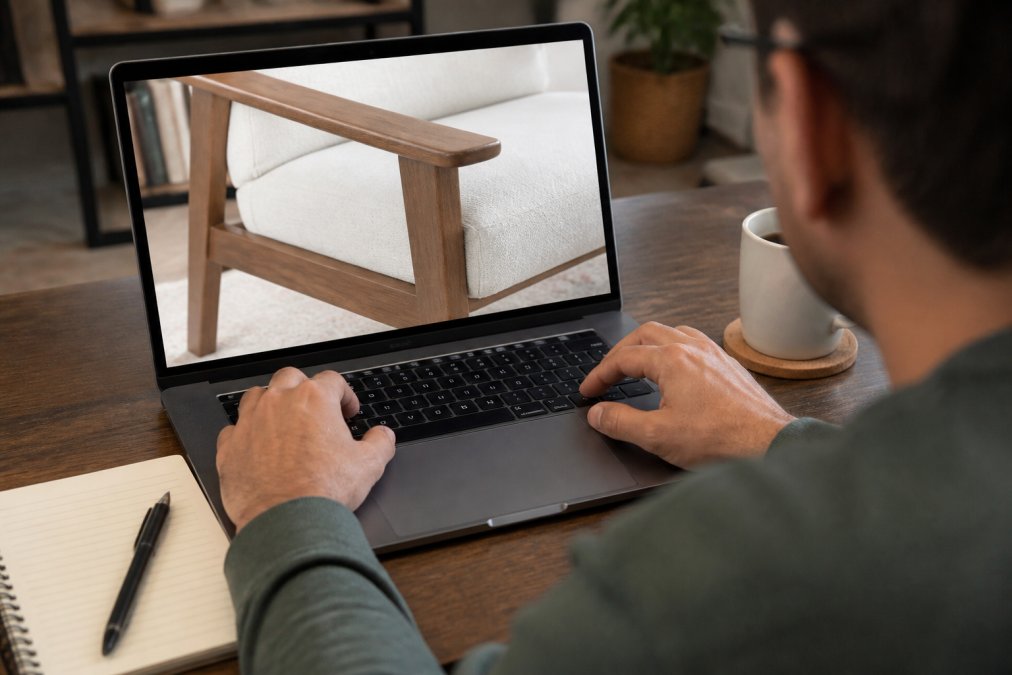
Zoom in on these areas:
- Corners and joints: Look for tight seams and visible joinery, not gaps
- Drawer fronts: Check that they align evenly across the piece
- Legs: Solid wood legs show grain; hollow ones look uniform and cheap
- Fabric texture: A close-up shot should show weave, not a blurry blur
- Background: A clean, real room beats a floating cutout
Furniture Return Policy Importance: Protecting Your Purchase
Furniture return policy importance comes down to one thing: risk. When you cannot inspect a piece in person, the return window is your safety net. Read it before you buy, the way a claims adjuster would, the fine print is where low-quality sellers hide.
Start with the terms every policy should state plainly:
- Return window: How many days from delivery, not from order date?
- Condition rules: Must it be unopened, or can it be assembled and still returned?
- Shipping costs: Who pays return freight on a 150-pound item?
- Restocking fees: Some sellers charge a percentage of the item price.
- Refund vs. store credit: Know which one you get, and how long the refund takes.
How to Assess Furniture Quality Online: A Step-by-Step Checklist
To assess furniture quality online, work through a fixed checklist every time. This keeps you from getting swept up in a good photo and a low price.
Here is the process:
- Read the full spec sheet and note material, weight capacity, and dimensions
- Zoom into every photo and look for tight seams, aligned drawers, and solid legs
- Check the item weight against similar pieces; heavier often means sturdier
- Confirm the return window and who pays return shipping
- Search the model for recalls or complaints
- Compare price against the materials you are actually getting
- Check assembly requirements and whether tools are included
- Read recent customer reviews and look for patterns, not one-off rants
| Check | What to Look For | Why It Matters |
|---|---|---|
| Material | Named hardwood, foam, or leather | Tells you real durability |
| Weight capacity | A stated number in pounds | Shows build strength |
| Photos | Close-ups of joints and seams | Reveals hidden flaws |
| Return window | Days allowed plus who pays | Protects your money |
| Reviews | Repeated praise or complaints | Shows real-world wear |
Common Mistakes When Assessing Furniture Quality Online
The biggest mistake is buying on price alone. A low price on unnamed materials usually means a short lifespan, and replacing the piece in a year costs more than buying well once.
Other frequent errors:
- Trusting a single hero photo instead of the full gallery
- Skipping the return policy until after delivery
- Ignoring item weight, which signals build density
- Assuming "solid wood" means every part is solid
- Overlooking assembly difficulty on large pieces
Where Value and Quality Meet
Assessing furniture quality online is a skill that gets easier with practice. Read the specs, zoom into the photos, check the return terms, and compare price against real materials, then you can buy with confidence without ever stepping into a showroom.
View all
Frequently Asked Questions
How can you tell if furniture is high-quality from online photos?
Zoom in on photos to check for tight seams, even finishes, and clear wood grain patterns. Look for multiple angles and close-ups of joints and hardware. A quality listing shows detailed shots, not just a wide view. If the photos are blurry or only show one angle, that's a red flag. Also, check for real customer photos in reviews to see how the piece looks in actual homes.
What materials should I look for in durable furniture?
Look for kiln-dried hardwood frames, high-density foam cushions, and top-grain leather or tight-weave upholstery. Engineered wood is fine for budget pieces if it's thick and well-supported. Avoid particleboard for load-bearing parts. Check specifications for weight capacity and material details. For example, the 60" Retro Buffet Cabinet uses solid wood legs and engineered wood panels, with a tabletop that supports up to 220 pounds.
Are customer reviews a reliable way to assess furniture quality?
Reviews help, but read them critically. Focus on comments about durability, assembly, and how the piece holds up after months. Look for patterns in complaints. A few negative reviews are normal, but repeated issues with wobbling or peeling indicate poor quality. Photos from reviewers are especially useful for judging color and scale. Combine review insights with spec checks for a full picture.
What are the signs of poor-quality furniture construction?
Watch for staples instead of joinery, thin veneers over particleboard, and flimsy back panels. If the listing doesn't mention frame material or joinery, ask. Also, check return policies: a short window or high restocking fees can signal low confidence in the product. For online buys, prioritize pieces with clear specs and a 30-day return option, like many Payless Home Goods items.